School leaders operate in conditions of persistent complexity. They lead across cultures, curricula, languages, and regulatory frameworks, while simultaneously being expected to deliver academic excellence, safeguard well-being, and innovate for futures that remain uncertain. Yet many prevailing leadership models still assume stability, predictability, and hierarchical control. What if the central leadership challenge today is not about being more decisive or efficient, but about learning how to lead thinking, not just people?
In this article, I emphasize that sustainable innovation in international and public schools arises when leadership is redefined as a community-centered practice. Drawing on concepts from transformational leadership, distributed leadership, and creativity research, and grounded in the frameworks established in “Leadership in International Schools” and “Leadership Intelligences and Capabilities,” the article examines how leaders can have an impact in creating and developing collective genius, in other words, the ability of a school community to think, learn, and act together.
Traditional leadership effectiveness has long been associated with clarity of vision, moral purpose, and individual authority. Transformational leadership emphasised inspiration and values, encouraging followers to transcend self-interest in pursuit of shared goals (Burns, 1978; Bass and Riggio, 2006). In education, this moral dimension remains essential. However, evidence consistently shows that when leadership focuses on formal roles, schools struggle to respond to complexity, uncertainty, and rapid change (Bolden, 2011). Distributed leadership emerged as a corrective, reframing leadership as a practice stretched across people, roles, and situations rather than looking in individuals alone (Spillane, 2006; Harris, 2013). Yet even when leadership is distributed, many schools remain efficient but unimaginative. The missing dimension is often creativity. As argued in Leadership in International Schools (Banchini, 2020), creativity in leadership is not an optional enrichment; it is a core capability that enables leaders to navigate ambiguity, understand competing demands, and design new possibilities. Creativity is not an individual talent but a social process, developed through dialogue, experimentation, and reflection (Amabile, 1996; Sawyer, 2012). Without creativity, leadership risks becoming compliant rather than adaptive.
In international and public schools, leadership is less about controlling outcomes and more about designing conditions. The most effective leaders focus not only on what they do personally, but on what the community becomes capable of doing together. This reflects a shift articulated in Leadership Intelligences and Capabilities (Banchini, 2025), where leadership is framed as a set of interconnected intelligences such as strategic, relational, cultural, pedagogical, reflective, entrepreneurial, and heuristic, and enable leaders to work with complexity rather than against it.
The central leadership question, therefore, changes: From How do I lead better? To How do I help others think, lead, and innovate?
Leadership becomes a practice of community design, shaping purpose, relationships, and learning processes so that creativity and innovation can emerge organically.
To make this shift actionable I thought about the C³ Framework. Clarity, Collective Agency and Creative Action
The C³ Framework integrates three mutually reinforcing dimensions of leadership:
- Clarity of Purpose (transformational leadership)
- Collective Agency (distributed leadership)
- Creative Action (innovation through practice)
Through these processes, you can see how they provide a coherent and flexible model for leading complex multicultural learning communities.
C¹ — Clarity of Purpose
Transformational leadership begins with meaning. People engage creatively when they understand why their work matters and how it contributes to a shared moral purpose (Burns, 1978). In international and public schools, shared purpose cannot be assumed. Cultural diversity, varied professional traditions, and different communities require leaders to continuously construct meaning through dialogue.
In practice, this involves:
- Treating vision as an ongoing conversation rather than a fixed statement
- Making values visible in everyday decisions
- Modelling moral courage when purpose conflicts with convenience
A practical leadership move is to replace one operational agenda item in a leadership or staff meeting with a reflective question, such as: What are we currently doing that aligns with our values, and what no longer does?
This emphasises that creativity should be driven by a clear purpose rather than merely pursuing novelty for its own sake.
C² — Collective Agency
Distributed leadership is most powerful when it is intentional rather than accidental. Leadership should flow to expertise and context while remaining aligned to shared purpose (Spillane, 2006; Harris, 2013). This aligns closely with the relational and cultural intelligences described in Leadership Intelligences and Capabilities (Banchini, 2025), where influence is built through trust, credibility, and shared responsibility.
In practice, this means:
- Valuing informal leadership alongside formal roles
- Creating structures for shared decision-making without ambiguity
- Shifting from permission-based cultures to trust-based ones
A practical leadership move is to establish short-term Leadership Circles around real challenges (e.g. assessment, wellbeing, inclusion). These groups:
- Include diverse voices
- Have a clearly defined purpose
- Are empowered to test small-scale solutions
This builds ownership while maintaining coherence.
C³ — Creative Action
Creativity becomes innovation only when ideas are enacted, reflected upon, and refined. Psychological safety is critical to this process (Edmondson, 2018). As argued in Leadership in International Schools (Banchini, 2020), leaders must normalise unfinished thinking, experimentation, and reflective failure if creativity is to translate into meaningful change.
In practice, this involves:
- Treating prototypes as learning tools
- Reframing failure as data rather than deficiency
- Valuing learning processes as much as outcomes
A practical leadership move after any initiative or pilot, the leader should guide teams through three questions:
- What did we try?
- What did we learn?
- What will we adapt next?
This embeds creativity into everyday professional practice. Why are reflection and action essential for leadership? International and public schools are uniquely positioned to benefit from this integrated approach. Their diversity, interdisciplinary focus, and global perspective create fertile ground for collective creativity, if leadership enables it.
The C³ Framework also cultivates transferable capabilities that extend beyond education:
- Systems thinking (economics, policy)
- Collaboration and facilitation (leadership, business)
- Pattern recognition and problem-solving (STEM)
- Ensemble thinking and improvisation (arts, music)
If leaders make explicit connections, they can help communities experience learning as integrated rather than fragmented.
In a community-centred model, leaders are not the centre of the system. They are architects of conditions.
They design structures that enable trust and dialogue, protect time for reflection and learning, model curiosity and humility, and make leadership safe to share. As Edmondson (2018) reminds us, innovation flourishes where people feel safe to speak, question, and experiment. That safety is not accidental, but it is intentionally led. The future of education will not be shaped by the most charismatic leaders or the most detailed strategies. It will be shaped by communities that can think deeply, adapt intelligently, and create together. The most important leadership question today is not: “How do I lead?” But rather: “How do I help others lead, think, and create together?”
When we come together, we can achieve what once seemed impossible. It’s about building connections, supporting one another, and inspiring each other. Rather than relying on a single vision, we create ideas that reflect diverse experiences and perspectives. Together, we can create collaborative work on this educational journey of collective genius, where every contribution matters, and inspire paths we never knew existed.
References
Amabile, T.M. (1996). Creativity in context. Boulder, CO: Westview Press.
Banchini, F. (2020). Leadership in International Schools. London: Visible Press.
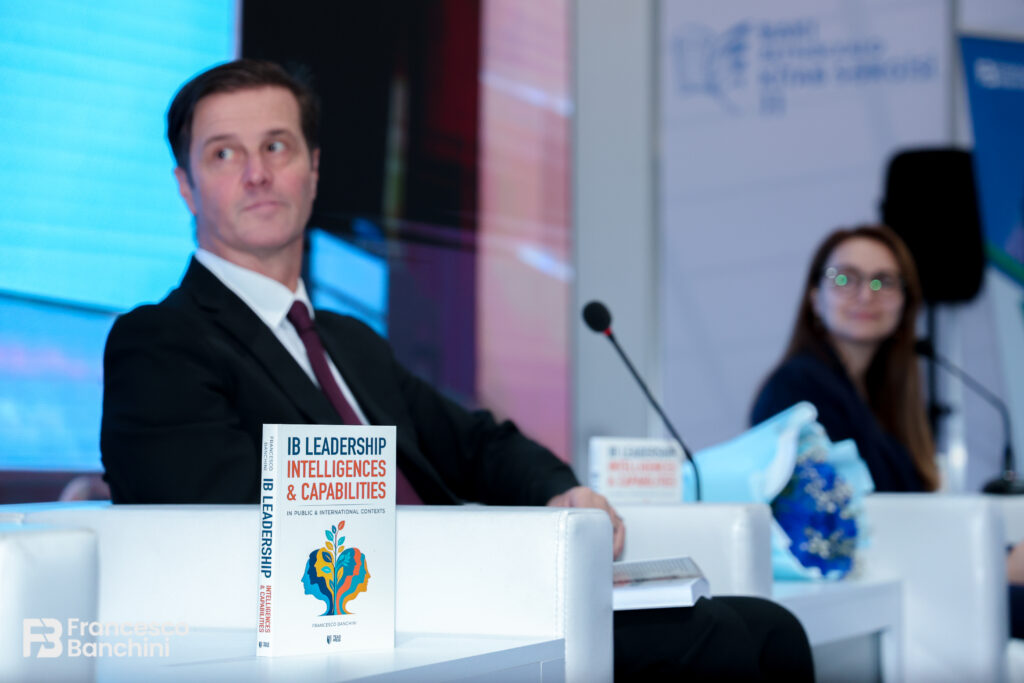
Banchini, F. (2025) IB Leadership Intelligences and Capabilities. Baku: TEAS Press.
Bass, B.M. and Riggio, R.E. (2006). Transformational leadership. 2nd edn. Mahwah, NJ: Lawrence Erlbaum.
Bolden, R. (2011) ‘Distributed leadership in organisations’, International Journal of Management Reviews, 13(3), pp. 251–269.
Burns, J.M. (1978). Leadership. New York: Harper & Row.
Edmondson, A. (2018). The fearless organisation. Hoboken, NJ: Wiley.
Harris, A. (2013) ‘Distributed leadership: Friend or foe?’, Educational Management Administration & Leadership, 41(5), pp. 545–554.
Sawyer, R.K. (2012). Explaining creativity. Oxford: Oxford University Press.
Spillane, J.P. (2006). Distributed leadership. San Francisco: Jossey-Bass.